If you have spent any time baking gluten free, you have run into both of these ingredients. Gelatin vs xanthan gum gluten free baking is one of the most common questions in the gluten free community — and one of the most poorly answered. Most articles tell you they are interchangeable. They are not.
Choosing gelatin or xanthan gum gluten free baking depends entirely on what you are making. Use the wrong one and you will get gummy bread, flat biscuits, or cake that bounces when you press it. Use the right one and your baked good will have the texture you were hoping for.
I have tested both binders extensively across dozens of gluten free recipes at The Savory Hearth. This is the gelatin vs xanthan gum gluten free breakdown I wish I had found when I started. No fluff. Just the information you need to make the right choice for each recipe.
To see the difference for yourself, start with the complete gelatin trick gluten free guide — it covers the full technique before you dive into any specific recipe.
Here is your complete gelatin vs xanthan gum gluten free guide — what each one is, how each one works, when to use each, and what happens when you get it wrong.
Quick answer: Gelatin = bread, pizza, pasta, biscuits. Xanthan gum = cakes, cookies, muffins. When in doubt, check the quick decision guide at the bottom of this article.
Table of Contents
Table of Contents
What Is the Difference: Gelatin vs Xanthan Gum Gluten Free?
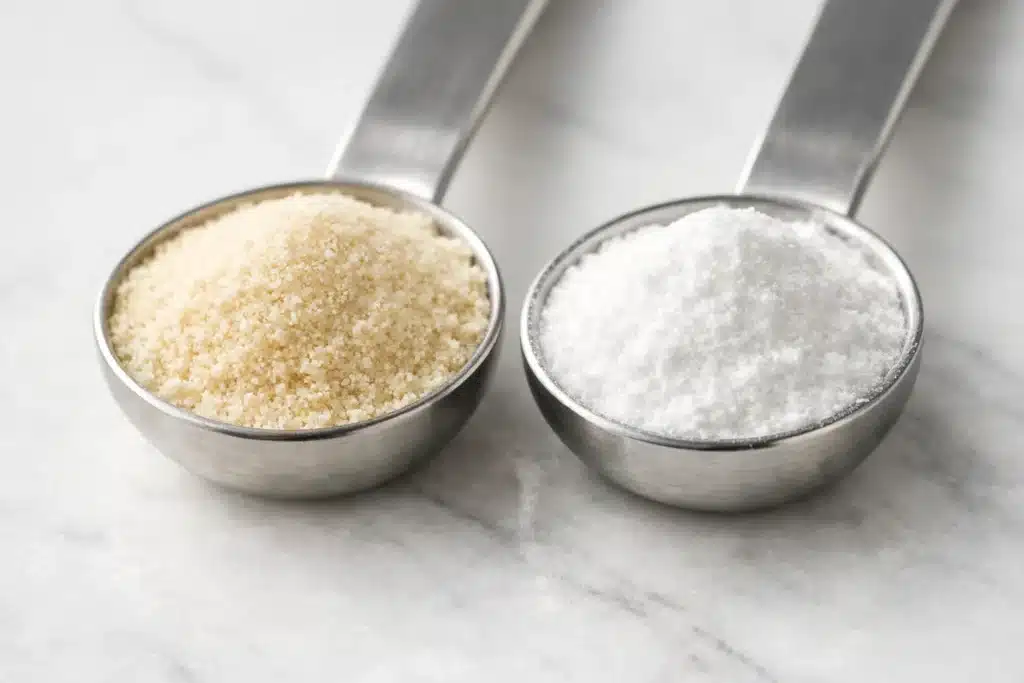
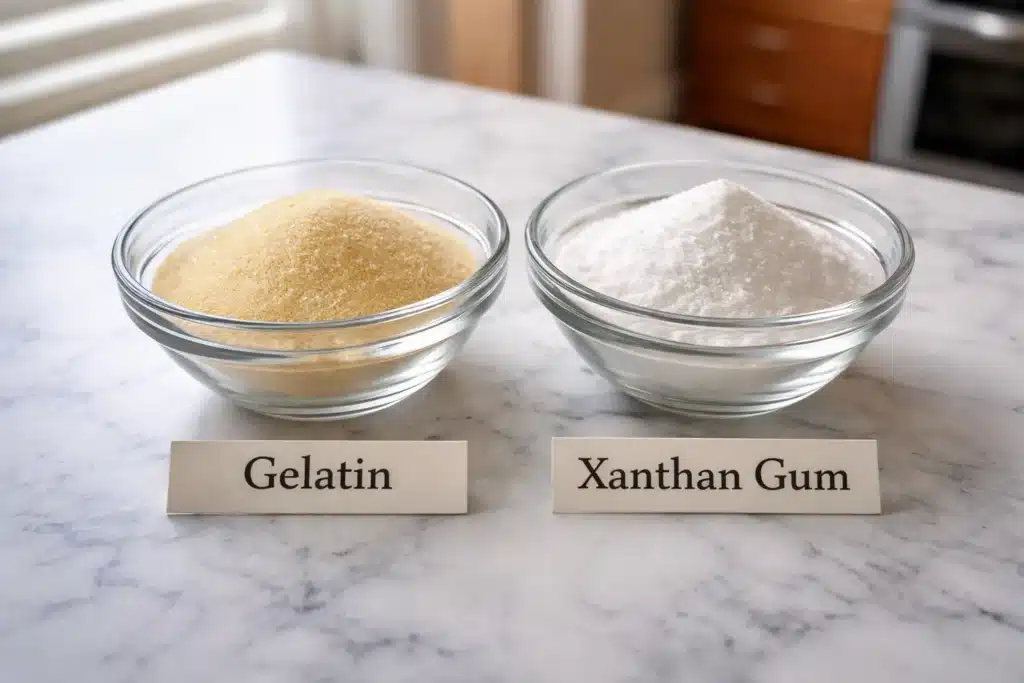
The most fundamental difference in the gelatin vs xanthan gum gluten free comparison is their source. Gelatin comes from animal collagen — the protein extracted from cattle or pig bones and connective tissue. It is a whole-food ingredient that has been used in cooking for centuries. According to the FDA collagen and gelatin guidelines, pure unflavored gelatin contains no gluten and is safe for gluten free diets.
Xanthan gum is a polysaccharide produced by fermenting simple sugars (typically from corn) with a specific bacteria called Xanthomonas campestris. The result is a powder that becomes extremely viscous when hydrated. In the gelatin or xanthan gum gluten free comparison, xanthan gum is the more processed option — but it is also vegan, requires no special preparation, and works in a wider range of baked goods when used correctly.
How Gelatin vs Xanthan Gum Gluten Free Baking Works
Understanding the gelatin vs xanthan gum gluten free mechanism is the key to using both correctly. Gluten free baking fails without a binder because gluten free flours cannot form the elastic protein network that holds wheat dough together. Both gelatin and xanthan gum attempt to replace that network — but they do it differently.
How Gelatin Works
Gelatin is a protein. When bloomed in liquid and incorporated into dough, the collagen protein chains form a flexible, elastic matrix that behaves like gluten under baking conditions. It traps gas bubbles from yeast or baking powder, allows dough to stretch without tearing, and sets as the baked good cools — creating chew and structural integrity.
The key requirement: gelatin must be bloomed in liquid first, then melted before adding to the recipe. It cannot be mixed dry into flour like xanthan gum.
How Xanthan Gum Works
Xanthan gum is a hydrocolloid. It works by absorbing water and becoming extremely thick and viscous. This viscosity creates a sticky, cohesive mixture that holds gluten free flour particles together. It does not form a protein network — instead, it acts more like glue. The result is a dough that holds together but lacks the elasticity and chew of a protein-based network.
Xanthan gum requires no preparation. Add it directly to dry ingredients and it activates when it contacts liquid during mixing.
FULL COMPARISON TABLE — gelatin vs xanthan gum gluten free
| Category | Gelatin | Xanthan Gum | Winner |
| Source | Animal collagen — whole food | Fermented corn sugar — processed | Gelatin |
| Texture result | Chewy, elastic, open crumb | Dense, gummy if over-used | Gelatin (savory) |
| Best application | Bread, pizza, pasta, biscuits | Cakes, cookies, muffins | Depends |
| Preparation | Must bloom + melt before use | Mix directly into dry flour | Xanthan gum |
| Digestion | Well tolerated by most | Can cause bloating in sensitive people | Gelatin |
| Vegan? | No — use agar agar instead | Yes | Xanthan gum |
| Cost | Affordable, widely available | Affordable, widely available | Tie |
| Shelf life | 2–3 years sealed | 2–3 years sealed | Tie |
| Flavor impact | None detectable | None detectable | Tie |
| Rise support | Excellent — traps gas bubbles | Moderate | Gelatin |
| Stretch/elasticity | High — like gluten | Low — more plastic than elastic | Gelatin |
| For tender crumb | Not ideal — adds chew | Better for light, tender results | Xanthan gum |
Texture Results: Gelatin vs Xanthan Gum Gluten Free
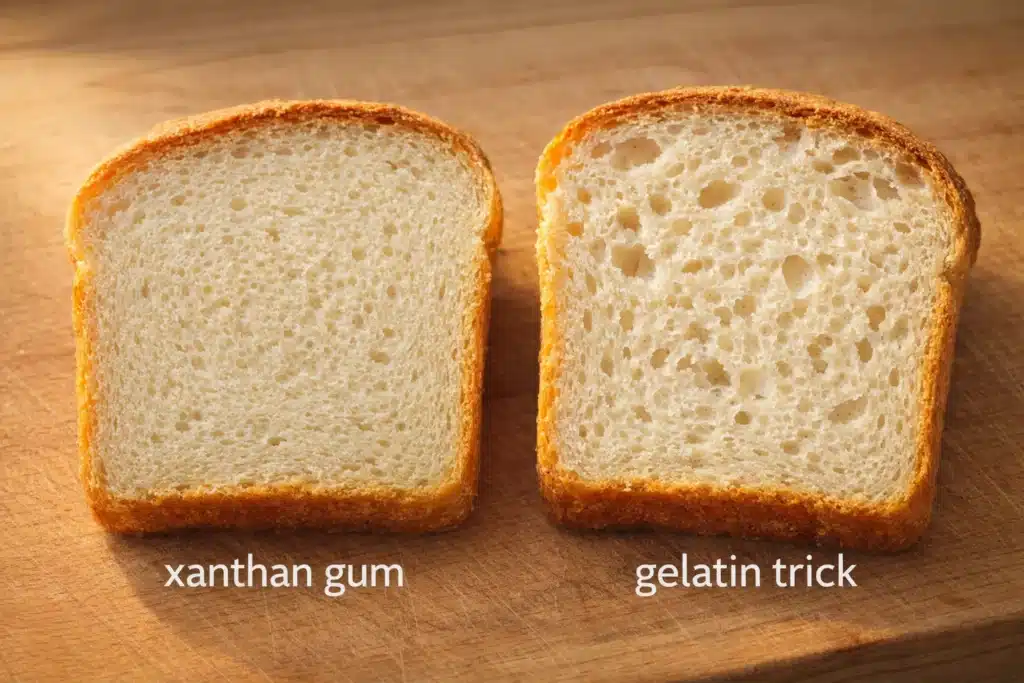
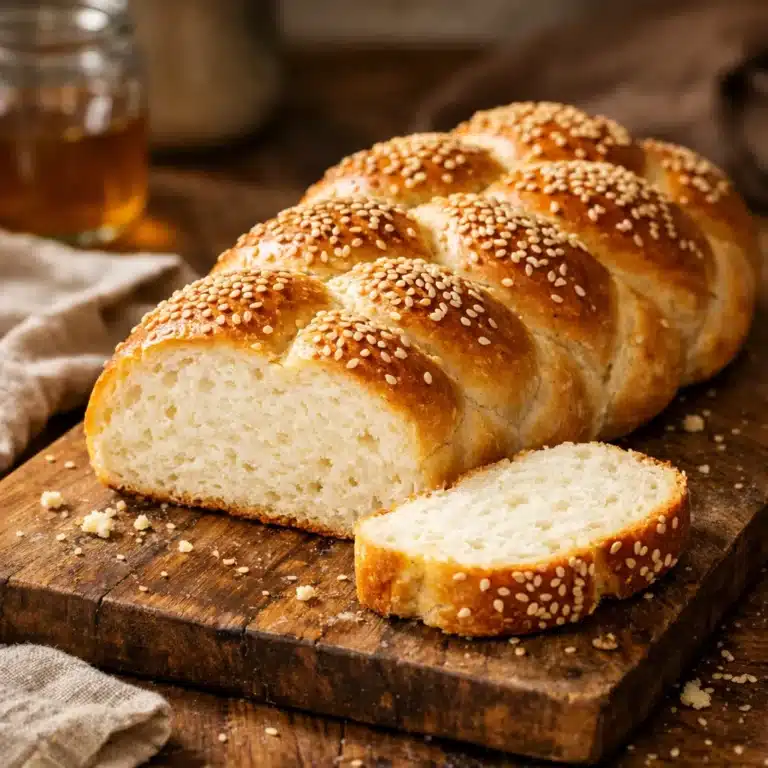
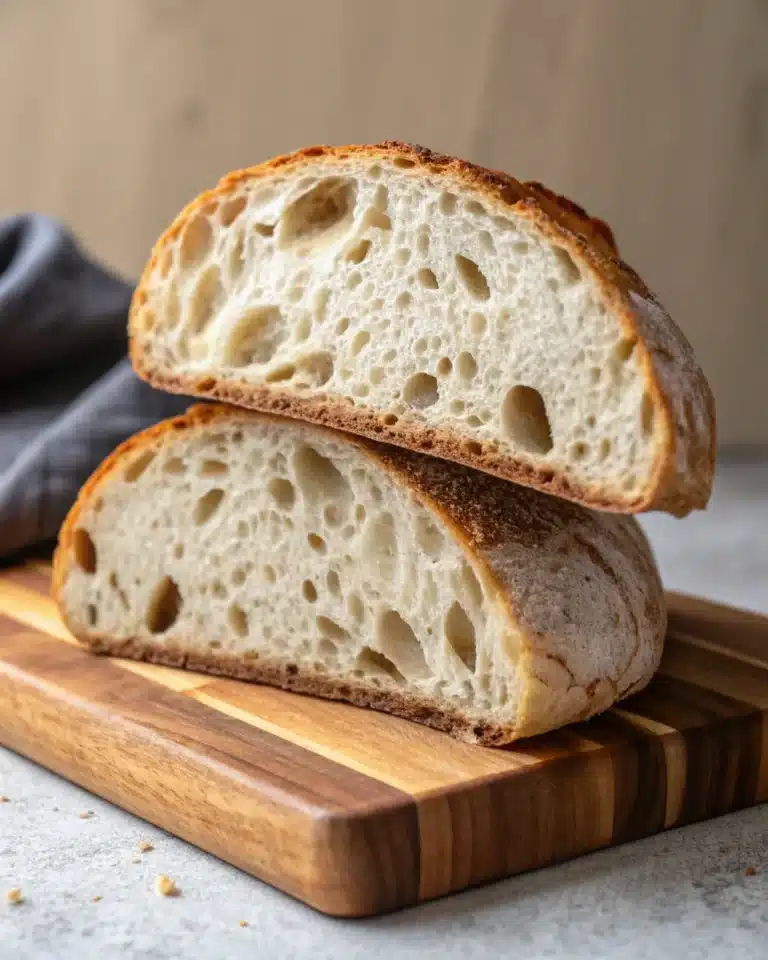
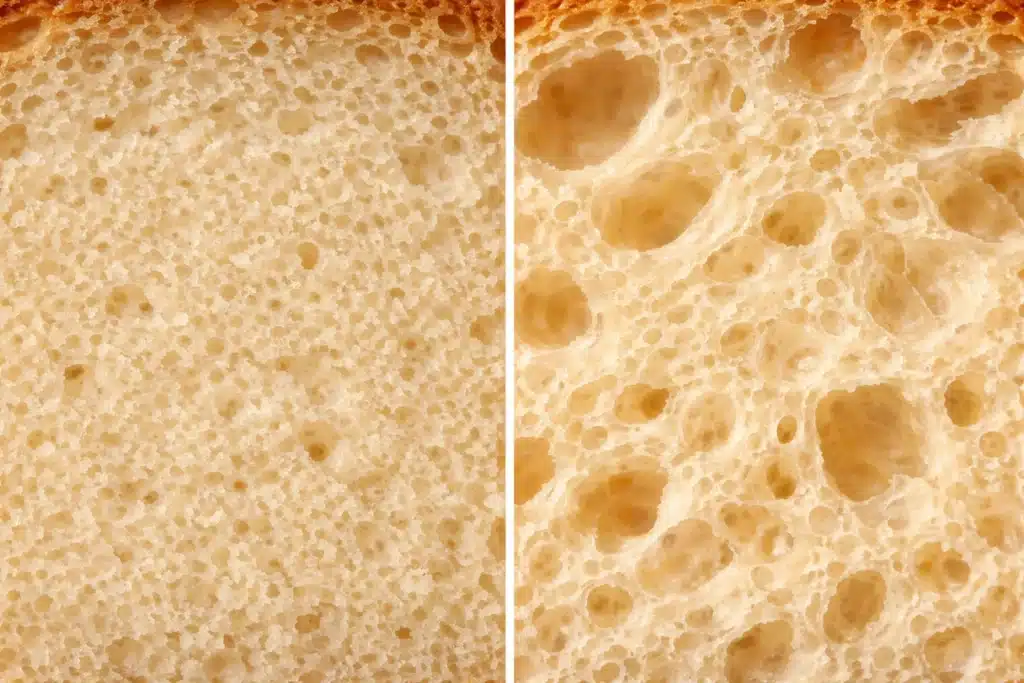
In the gelatin vs xanthan gum gluten free bread texture comparison, the difference is visible and significant. A loaf made with gelatin has a more open crumb — you can see the air pockets where gas was trapped during baking. It slices cleanly, holds together without crumbling, and has a satisfying chew when you bite into it.
For savory comfort food, try homemade gelatin gluten free pasta dough or tall gelatin gluten free biscuits — both show exactly what gelatin does that xanthan gum cannot.
A loaf made with xanthan gum has a denser, more uniform crumb. It holds together but can feel gummy, especially if even slightly over-measured. In the gelatin or xanthan gum gluten free chew comparison, gelatin produces a more appealing texture in bread — closer to wheat bread — while xanthan gum tends toward a texture that feels distinctly gluten free.
When to Use Gelatin vs Xanthan Gum Gluten Free
Use gelatin in the gelatin vs xanthan gum gluten free bread comparison whenever your recipe needs real chew, elasticity, or structural height. Gelatin wins in:
- Yeast breads — the gelatin network supports rise and creates chew
- Pizza dough — gelatin vs xanthan gum gluten free pizza: gelatin gives real stretch, xanthan gum tears
- Pasta dough — gelatin allows thin rolling without cracking
- Biscuits — gelatin creates visible layers and tall rise
- Savory pie crust — gelatin gives rollability and flakiness
- Any dough that needs to be shaped, stretched, or rolled
The most dramatic results come in gelatin gluten free bread — that is where the difference between the two binders is most visible — followed closely by gelatin gluten free pizza dough where the stretch improvement is immediate.
When Xanthan Gum Wins Over Gelatin Gluten Free
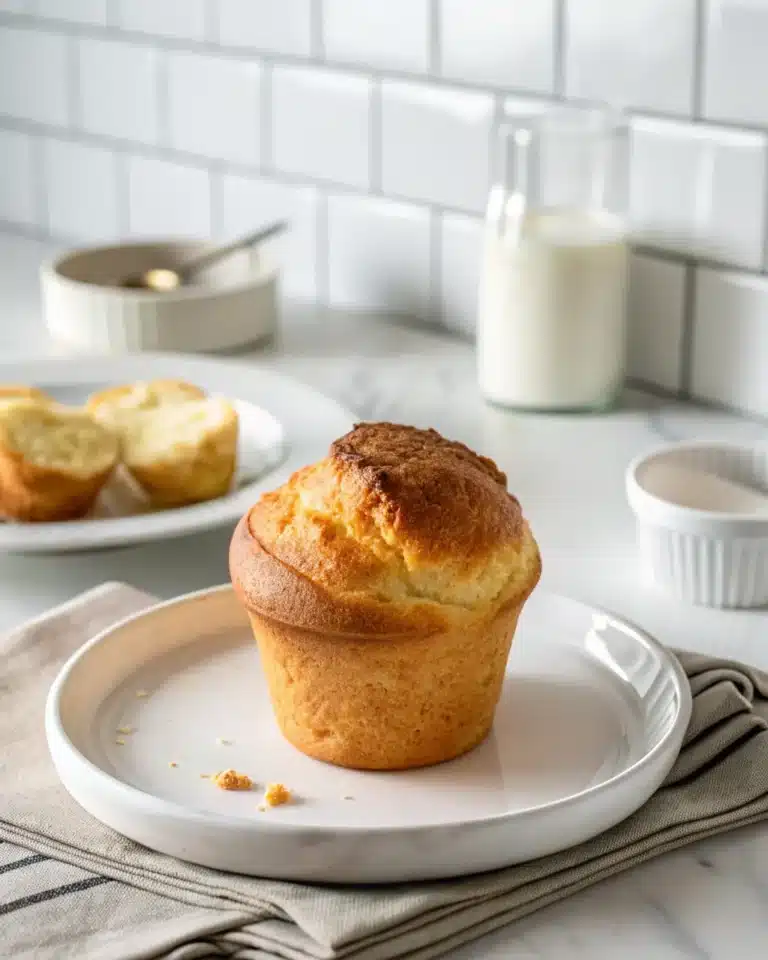
In the xanthan gum vs gelatin gluten free cakes comparison, xanthan gum is the clear winner. Cakes need a light, tender crumb — the kind of texture that melts in your mouth. Gelatin adds protein structure and chew, which is exactly what you do not want in a birthday cake or a soft cupcake.
In the gelatin vs xanthan gum gluten free cookies comparison, xanthan gum is also the better choice for most styles. Drop cookies and shortbread need a specific spread and crumble that gelatin works against. Xanthan gum provides cohesion without adding elasticity.
Use xanthan gum in:
- Cakes and cupcakes — tender crumb, delicate texture
- Drop cookies and shortbread — correct spread and snap
- Muffins and quick breads — lighter leavening mechanism
- Pancakes and waffles — soft, fluffy texture
- Any recipe where tenderness and lightness are the goal
Can You Use Gelatin and Xanthan Gum Together Gluten Free?
Yes — and in the gelatin vs xanthan gum gluten free combined approach, some recipes benefit from both. The combination works best in enriched breads (like brioche or sandwich loaves) and in biscuits where you want both the protein structure of gelatin and the cohesion of xanthan gum.
When combining both, reduce each by half from what the recipe calls for. Using both at full amounts produces a texture that is too dense, too sticky, and unpleasant. The rule is:
- Full gelatin + 0 xanthan gum = best for lean yeast breads, pizza, pasta
- Half gelatin + half xanthan gum = good for enriched breads, biscuits, savory pastry
- 0 gelatin + full xanthan gum = best for cakes, cookies, muffins, pancakes
Daniel’s note: When I am testing a new gluten free recipe and I am not sure which binder to use, I ask one question: does this recipe need to stretch, chew, or rise tall? If yes, gelatin. If the goal is tender and light, xanthan gum.
Gelatin vs Xanthan Gum Gluten Free — Substitution Ratios
When converting a recipe in the gelatin vs xanthan gum gluten free ratio substitution, the measurements are not 1:1. Here are the reliable conversion ratios based on testing:
| Recipe Type | Xanthan Gum Amount | Gelatin Equivalent |
| Bread (1 loaf) | 1 tsp xanthan gum | 1 tsp bloomed gelatin per cup flour |
| Pizza dough | 1/2 tsp xanthan gum | 1/2 tsp bloomed gelatin per cup flour |
| Pasta dough | 1 tsp xanthan gum | 1 tsp bloomed gelatin per 2 cups flour |
| Pie crust | 1/4 tsp xanthan gum | 1/2 tsp bloomed gelatin per crust |
| Biscuits | 1/2 tsp xanthan gum | 1/2 tsp bloomed gelatin per batch |
| Cake | 1/4 tsp xanthan gum | Not recommended — keep xanthan gum |
| Cookies | 1/4 tsp xanthan gum | Not recommended — keep xanthan gum |
Gelatin vs Xanthan Gum Gluten Free — Digestion and Health
In the gelatin vs xanthan gum gluten free tolerance comparison, gelatin has the advantage for most people. It is a natural protein that the human digestive system handles well. Many people report that switching from xanthan gum to gelatin in their baking reduces the bloating and digestive discomfort they associated with gluten free bread.
Xanthan gum is a fiber-like substance. In small amounts it is well tolerated. In larger amounts — or in people with sensitive digestive systems — it can cause gas, bloating, and discomfort. This is particularly relevant for people with celiac disease, who may already have compromised gut function.
Neither ingredient has a significant caloric contribution at the amounts used in baking. Gelatin does add a small amount of protein per serving — typically 1 to 2 grams depending on the amount used — which can be a useful addition in gluten free recipes that are often lower in protein than their wheat-based counterparts.
Vegan Option: Gelatin vs Xanthan Gum Gluten Free
In the gelatin or xanthan gum gluten free vegan comparison, xanthan gum wins by default — it is plant-based and suitable for vegan diets. Gelatin is derived from animal collagen and is not vegan.
If you follow a vegan diet and want the benefits of gelatin in your baking, agar agar is the plant-based alternative. Derived from seaweed, agar agar can be used at approximately 3/4 teaspoon for every 1 teaspoon of gelatin. Important differences:
- Agar sets firmer and is less elastic than gelatin
- Agar does not melt back when warm — it sets permanently once cooled
- Results are slightly different from gelatin — expect a somewhat denser texture
- Still significantly better than using no binder at all in bread and pizza applications
Quick Decision Guide: Gelatin vs Xanthan Gum Gluten Free
Here is the gelatin vs xanthan gum gluten free quick decision guide for every common baking scenario:
| You are making… | Use Gelatin? | Use Xanthan? | Best choice |
| Sandwich bread | Yes ✔ | Optional | Gelatin |
| Pizza dough | Yes ✔ | No | Gelatin |
| Pasta dough | Yes ✔ | No | Gelatin |
| Biscuits | Yes ✔ | Optional | Gelatin |
| Pie crust (savory) | Yes ✔ | Optional | Gelatin |
| Cake / cupcakes | No | Yes ✔ | Xanthan gum |
| Drop cookies | No | Yes ✔ | Xanthan gum |
| Shortbread | No | Yes ✔ | Xanthan gum |
| Muffins | No | Yes ✔ | Xanthan gum |
| Pancakes / waffles | No | Yes ✔ | Xanthan gum |
| Enriched bread | Half | Half | Both (half each) |
| Vegan recipe | Use agar | Yes ✔ | Xanthan gum |
Frequently Asked Questions
Gelatin vs xanthan gum gluten free — which one is actually better?
Neither is universally better. Gelatin is better for recipes that need chew, stretch, and height: bread, pizza, pasta, biscuits. Xanthan gum is better for recipes that need tenderness and lightness: cakes, cookies, muffins. The right answer depends entirely on what you are baking.
How much gelatin vs xanthan gum gluten free per cup of flour?
The gelatin vs xanthan gum gluten free amount varies by recipe. For bread, use 1 teaspoon of bloomed gelatin per cup of flour or 1 teaspoon of xanthan gum per loaf. For pizza, use 1/2 teaspoon of gelatin per cup of flour or 1/4 teaspoon of xanthan gum. Always use the amounts in the recipe rather than estimating — both ingredients become problematic when overused.
Can I replace xanthan gum with gelatin in my gluten free bread recipe?
Yes — in the gelatin or xanthan gum gluten free bread swap, replace xanthan gum entirely with gelatin at a starting ratio of 1 teaspoon of bloomed gelatin for every 1/4 teaspoon of xanthan gum. The bread will typically have a better rise, more open crumb, and superior chew. This is one of the most impactful swaps you can make in gluten free bread baking.
Does gelatin make gluten free baking taste different?
No. Both unflavored gelatin and xanthan gum are tasteless at the amounts used in baking. Your bread will not taste like aspic and your cake will not taste different from a version made with xanthan gum. Both binders contribute structure and texture only — not flavor.
Is gelatin or xanthan gum better for gluten free bread machines?
For bread machines, gelatin is generally the better choice. Bread machine recipes benefit from the stronger protein network that gelatin creates, which handles the mechanical mixing and high-heat baking environment better than xanthan gum. Add the bloomed, melted gelatin to your liquid ingredients before starting the machine.
Final Thoughts from Daniel
The gelatin vs xanthan gum question has a clear answer once you understand what each one actually does. Gelatin builds structure. Xanthan gum adds cohesion. For bread, pizza, and pasta, you want structure. For cakes and cookies, you want cohesion. That is the whole answer.
The gelatin vs xanthan gum gluten free answer is not one binder wins overall — it is that each one wins in its own category. Keep both in your pantry. Use the quick decision guide above. And if you are new to gelatin in baking, start with the bread recipe — that is where the difference is most obvious and most rewarding.
Questions about a specific recipe? Leave a comment below and I will give you a direct answer.Good luck. — Daniel Brooks, The Savory Hearth