
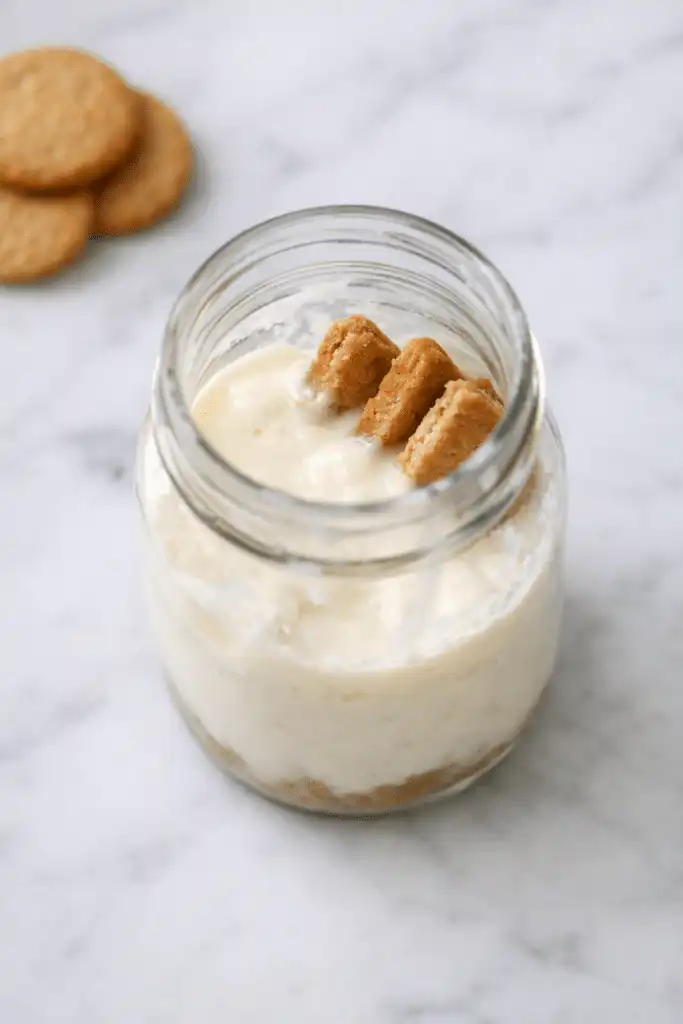
Your gluten free cheesecake won’t set — that is the single most common complaint I get about the viral Japanese cheesecake hack. You followed the recipe, you used Greek yogurt, you refrigerated for hours, and you opened the fridge to find a glass jar of liquid yogurt with sad soggy cookies floating in it.
The good news: a gluten free cheesecake that won’t set is almost always fixable. The cause is almost always one of seven specific problems. None of them are complicated. Most take under two minutes to solve on your next attempt.
In this guide I walk through every reason a gluten free cheesecake won’t set, how to diagnose which problem you have, and the precise fix for each one. By the end, your gluten free cheesecake will set firmly every time.
| ⚡ Cheesecake Won’t Set — Quick Diagnosis Yogurt still liquid after 4+ hours → Problem #1 or #2 (yogurt fat or gelatin) Cookies mushy but yogurt loose → Problem #3 (wrong cookie type) Liquid pooling at bottom → Problem #4 (whey separation) Set but texture is grainy → Problem #5 (gelatin lumps) Set then collapsed after 2 hours → Problem #6 (temperature) Set unevenly — firm on sides, liquid center → Problem #7 (jar size) |
Table of Contents
Table of Contents
Why Cheesecake Won’t Set: The 7 Root Causes
Before jumping into the fixes, understand that gluten free cheesecake won’t set for structural reasons — not random bad luck. The no-bake yogurt cheesecake works through protein gel formation, starch interaction from the cookies, and cold-temperature setting. When any one of these three systems fails, the yogurt stays liquid.
Here are the seven specific ways each system can fail.
Fix #1: Wrong Yogurt Fat Content — The #1 Reason Cheesecake Won’t Set
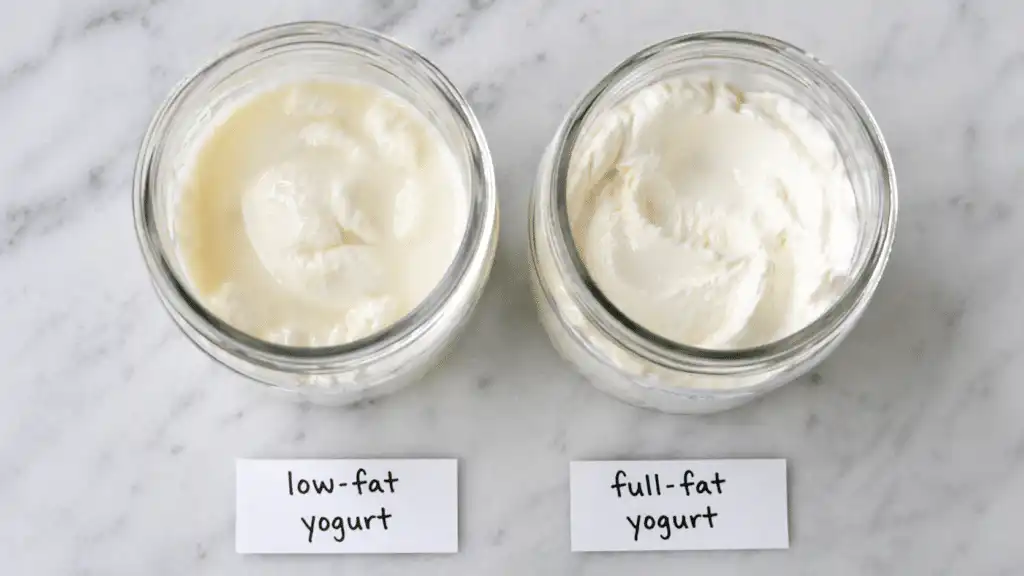
If your gluten free cheesecake won’t set after 4, 6, or even 8 hours, the most likely culprit is yogurt fat. Low-fat and non-fat Greek yogurt contain 70–80% more water than full-fat versions. That excess water prevents the protein network from firming — no matter how long you wait.
Full-fat Greek yogurt has roughly 5–8g fat per 100g and a thick, spoonable consistency straight from the tub. When you tilt a full-fat tub, the yogurt barely moves. If yours slides around freely, it is too thin and the hack will not work.
The fix
Switch to full-fat Greek yogurt (5% fat minimum) or skyr. Brands that consistently work: Fage Total 5%, Chobani Whole Milk, Siggi’s 4% Plain. If you only have low-fat on hand, strain it through a cheesecloth for 1 hour to remove excess whey, then increase gelatin to ¾ tsp per serving. The yogurt fat content is non-negotiable. For anyone with Celiac disease, always verify your yogurt is certified gluten-free — see gluten-free diet guidelines.
For the dairy-free version, use thick coconut yogurt with ¾ tsp gelatin.
Fix #2: Gelatin Error — The Second Most Common Reason Cheesecake Won’t Set
The second most common reason gluten free cheesecake won’t set is a gelatin mistake — four specific ways to get it wrong. Adding half a teaspoon of bloomed gelatin compensates for the different starch behavior of GF cookies compared to Biscoff. Skip it or mess it up, and nothing sets properly.
The 4 Gelatin Mistakes That Prevent Proper Setting
- Skipping the bloom: dry gelatin powder dumped directly into yogurt will not dissolve properly. The granules stay undissolved and create isolated gel pockets instead of a uniform network. The result is an uneven texture.
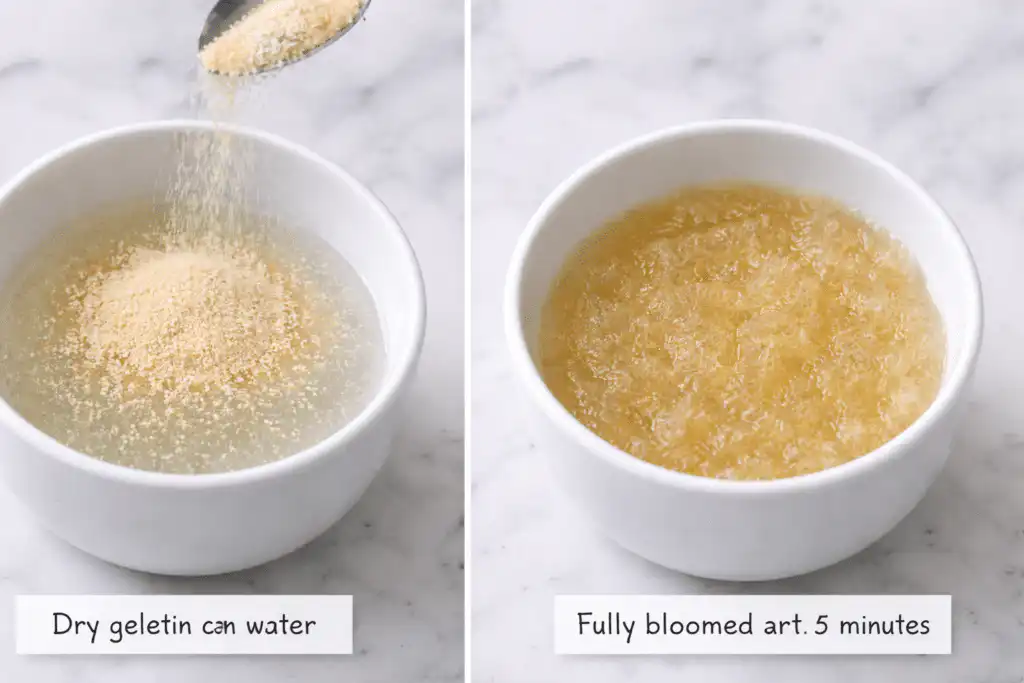
- Rushing the bloom: gelatin needs 5 full minutes in cold water to hydrate. A 2-minute bloom leaves partially hydrated granules that create lumps and a grainy texture.
- Overheating the gelatin: microwaving for more than 15 seconds can break the gelling proteins. Dissolved gelatin should be warm and clear, never boiling. If it bubbles in the microwave, the gelling proteins are destroyed.
- Letting the gelatin cool too long: liquid gelatin starts to gel at around 59°F. If you let it sit for more than 2 minutes after microwaving, it starts to set in the bowl and creates streaks in the yogurt.
The fix
Bloom ½ tsp gelatin in 1 tbsp cold water for exactly 5 minutes. Microwave 8–10 seconds until clear. Stir once. Immediately pour into yogurt in a thin stream while stirring constantly. Have the jars ready before you start this step. This single change fixes 80% of all cheesecake won’t set cases.
For the complete gelatin technique guide, see our full blooming walkthrough.
Fix #3: Wrong Cookie Type — Why Your Cheesecake Won’t Set Even With Good Yogurt
Gluten free cheesecake won’t set correctly even with full-fat yogurt and proper gelatin if you are using the wrong GF cookies. The cookies play an active structural role — their starch interacts with the yogurt moisture. Use a low-starch cookie and the result stays loose.
Rice wafers and thin rice crackers absorb moisture so fast that they contribute zero starch back to the yogurt — they just go soggy and the liquid stays loose. Pure almond flour cookies have almost no starch at all. GF Oreos have too much fat that migrates into the yogurt and interferes with setting.
The fix
Use Simple Mills Sweet Thins or Schar Biscotti exclusively. Simple Mills for 4–6 hours, Schar for overnight. Both have tapioca starch that releases slowly into the yogurt and actively contributes to the set — the only cookie swap that fully resolves a cheesecake won’t set caused by cookie type.
→ Full cookie comparison: Best Japanese Cheesecake Cookies Gluten Free — 8 tested and ranked →
Fix #4: Whey Separation — When Cheesecake Won’t Set and Liquid Pools at the Bottom
Whey separation is different from a full gluten free cheesecake won’t set failure. Here the yogurt has partially set but the liquid whey has separated and sunk. You will see a clear or yellowish pool under the firmed yogurt layer.
Whey separation happens for three reasons: the gelatin was not mixed in fast enough before it began to set at room temperature, the yogurt brand is naturally prone to weeping, or the jar was disturbed during the chilling period.
The fix
- Work faster after adding the gelatin — you have 5 minutes maximum before it starts to gel at room temperature.
- Switch yogurt brands. Fage, Chobani, and Siggi’s are the most stable. Generic store brands are often more prone to whey separation.
- Do not move or tilt the jars for the first 2 hours of chilling. Vibration during early gel formation causes whey separation.
- If whey separation has already happened: pour off the liquid, let the yogurt layer continue setting, then add toppings to cover the surface.
Fix #5: Gelatin Lumps — When Cheesecake Won’t Set Smoothly and Texture Is Grainy
A variation of the gluten free cheesecake won’t set problem is a grainy or lumpy texture instead of smooth and creamy. This is almost always undissolved gelatin granules that formed blobs instead of a uniform network.
Gelatin lumps happen when: the bloom was rushed (less than 5 minutes), the gelatin was added to cold yogurt straight from the fridge without warming slightly, or the dissolved gelatin was stirred into the yogurt too slowly and began setting in streaks before incorporation was complete.
The fix
Take the yogurt out of the fridge 10 minutes before assembling — not to warm it significantly, just to take the deep chill off. Room temperature yogurt gives you more working time. If you already have a grainy result, blend the yogurt layer for 15 seconds with an immersion blender, re-pour into the jar, and refrigerate again. The result will be slightly less firm but smooth.
Fix #6: Temperature Problems — Cheesecake Won’t Set or Sets Then Goes Liquid
If your gluten free cheesecake won’t set despite correct yogurt and gelatin — or sets then goes liquid — you have a temperature problem. Gelatin melts at approximately 77–95°F. The yogurt layer reliquefy quickly once removed from the fridge.
Signs of a temperature problem
- No setting after 8+ hours despite correct yogurt and gelatin → fridge too warm (above 40°F)
- Sets in fridge but becomes liquid within 10 minutes at room temperature → normal gelatin behavior, serve immediately
- Firm on bottom but loose on top layer → warm air pocket in fridge, move jar to back or bottom shelf
The fix
Verify your fridge is at 36–38°F using a thermometer. Place jars at the back of the bottom shelf where the temperature is most stable. Increase gelatin to ¾ tsp in warm-weather months and keep everything refrigerated until serving.
Fix #7: Wrong Jar Size — Why Cheesecake Won’t Set Evenly
The final reason gluten free cheesecake won’t set evenly is jar geometry. Wide, shallow containers have too much surface area relative to depth. The yogurt layer is too thin to set from edge to center at the same rate — firm edges, liquid center.
The same problem occurs in very deep, narrow containers where the gelatin sets the outer yogurt first and the warm center cannot escape heat fast enough to gel before the outer layer traps it.
The fix
Use 8oz wide-mouth mason jars. The straight sides and 3-inch depth are optimal for even setting. Stick to a yogurt depth of 2.5–3.5 inches — anything shallower causes the same uneven setting you see in flat bowls, and why cheesecake won’t set evenly in wide ramekins.
Cheesecake Won’t Set After All 7 Fixes? Try This Recovery Method
Addressed all seven problems and your gluten free cheesecake won’t set still? Here is the recovery method that works in almost every remaining case.
- Remove the jars from the fridge. Scrape the yogurt back into a bowl.
- Warm 1 tbsp of water in the microwave for 10 seconds. Bloom an additional ¼ tsp gelatin for 5 minutes, dissolve it, let it cool 30 seconds.
- Stir the extra gelatin into the yogurt vigorously for 30 seconds.
- Return to clean jars, re-insert fresh cookies, refrigerate overnight.
This recovery method works because you are adding structural reinforcement to yogurt that already has some partial setting — the combined gelatin creates a stronger network. The texture will be slightly firmer than the original recipe but fully acceptable.
Frequently Asked Questions
How long should I wait before deciding my cheesecake won’t set?
Give it a minimum of 4 hours with Simple Mills and gelatin. With Schar Biscotti, wait overnight (10–12 hours). If after 6 hours there is no firmness at all — not even around the edges — you have one of the seven problems above, most likely yogurt fat or a gelatin error.
Can I fix a cheesecake that won’t set after it has already been chilling?
Yes — use the recovery method above. The only unfixable case is boiled gelatin (destroyed gelling protein) or agar agar that fully set and cooled — agar does not re-melt as smoothly as gelatin.
Does cheesecake won’t set happen more in summer?
Yes. Gelatin is temperature-sensitive and warm ambient temperatures slow the process significantly. In summer, increase to ¾ tsp gelatin per serving, use full-fat yogurt straight from the coldest part of the fridge, and extend chilling time by 2 hours.
My cheesecake won’t set even with all full-fat yogurt and proper gelatin — what else could cause this?
Two overlooked causes: flavored yogurts sometimes contain starch thickeners that interfere with gelatin — use plain full-fat only. Some gelatin brands also have lower bloom strength — Knox is the most reliable US brand for this application.
Is cheesecake won’t set a problem with agar agar too?
Yes, differently. Agar sets at a higher temperature and creates a firmer texture. It sets faster too — add it to warm (not cold) yogurt and work very quickly. The texture will be more firm-jelly than creamy-cheesecake.
How do I know the difference between cheesecake won’t set and whey separation?
Poke the surface after 4 hours. Cheesecake won’t set = the spoon goes straight through, everything is uniform liquid. Whey separation = slight surface resistance but clear liquid pooled at the bottom. Different fixes — the first needs more gelatin or better yogurt, the second needs faster mixing.
Can I freeze a gluten free cheesecake that won’t set to help it firm up?
As a temporary fix, yes — 30 minutes in the freezer firms up the yogurt layer. But this is a band-aid. The issue returns after thawing unless you address the underlying cause. Use freezing only as an emergency rescue.
Final Thoughts: Cheesecake Won’t Set No More
Gluten free cheesecake won’t set frustrations are the single most common complaint about this hack. Two ingredients, no baking — and yet quite a lot can go wrong. Every problem here has a specific, actionable fix.
The three changes that solve 90% of gluten free cheesecake situations: full-fat Greek yogurt (Fage 5% or Siggi’s 4%), gelatin bloomed properly for 5 full minutes and added immediately, and Simple Mills Sweet Thins or Schar Biscotti as your GF cookies.
If your cheesecake won’t set after making those three changes, run through the remaining four fixes in order. The recovery method above has yet to fail.
| 📌 Related Guides → Full recipe: Gluten-Free Viral Japanese Cheesecake — complete step-by-step → Best Japanese Cheesecake Cookies Gluten Free — 8 tested and ranked → The Complete Gelatin Trick Guide for Gluten-Free Baking |